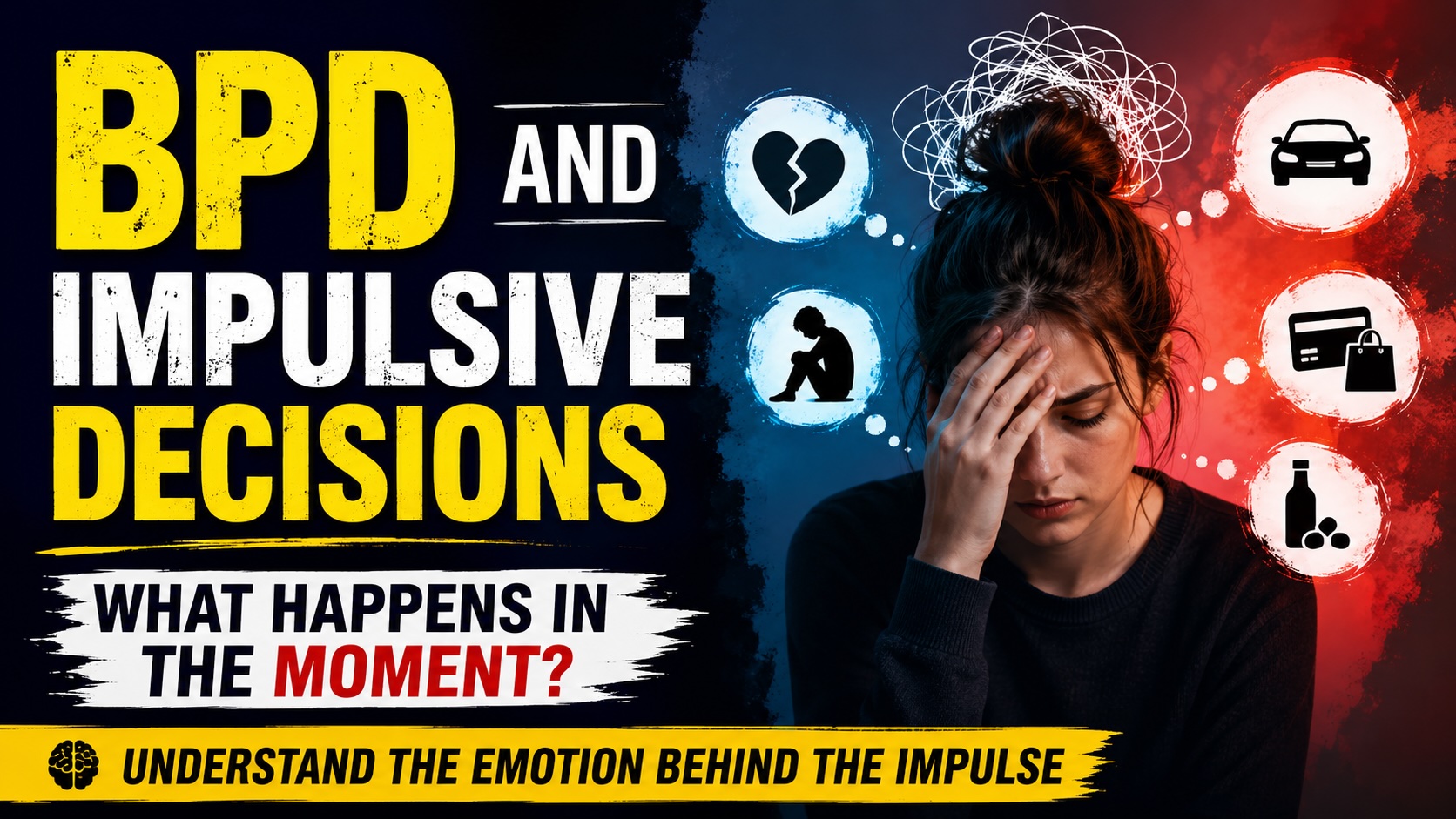
Impulsive decisions are one of the behaviours that can appear in Borderline Personality Disorder (BPD). A person may suddenly spend money, drive recklessly, use substances, engage in risky sexual behaviour, leave a relationship, or make another decision that they later regret. However, we should not assume that every impulsive action in BPD has the same cause.
Why Do People With BPD Make Impulsive Decisions?
The reasons behind BPD and Impulsive Decisions can vary significantly from person to person. What we see from outside may look like anger, sadness or an extreme reaction, but the trigger and underlying emotion can be very different.
For example, imagine a person with BPD experiencing rejection, loneliness, or the feeling that nobody gives them importance. Even a relatively small event can activate a very intense emotional response. Anger, sadness, fear or emotional pain may increase rapidly.
When emotional arousal becomes very high, the person’s ability to pause and consider long-term consequences may become weaker. Research on BPD has associated the condition with differences in emotional processing, impulse control and the interaction between brain regions involved in emotion and cognitive regulation.
What Happens in the Brain?
The amygdala plays an important role in detecting emotionally significant information, while the prefrontal cortex contributes to planning, inhibition and decision-making. In BPD, studies have found altered activity and connectivity involving these systems.
However, it would be inaccurate to say that the amygdala simply becomes “out of control” and the prefrontal cortex completely “switches off.” These brain systems continue to function, but intense emotional arousal can interfere with effective cognitive control.
Past experiences may also influence this process. Childhood adversity and chronic stress can affect brain development and emotional regulation. Some studies have reported differences in hippocampal structure in people with BPD, but this does not mean that childhood stress automatically causes a smaller hippocampus or that every person with BPD has the same brain changes.
When Emotion Becomes Difficult to Tolerate
During intense emotional distress, the immediate goal may become escaping the feeling rather than evaluating whether an action is sensible.
A person may think, “I need to get away,” “I have to do something now,” or “I cannot tolerate this anymore.” This can increase the possibility of impulsive behaviour such as reckless driving, substance use, risky sexual behaviour, sudden relationship decisions or abruptly leaving a situation.
If an impulsive behaviour produces immediate emotional relief, the brain can learn that behaviour as a quick way to reduce distress. This reinforcement can increase the likelihood of repeating it in the future.
Does This Mean They Don’t Know Right From Wrong?
No. This is an important distinction when discussing BPD and Impulsive Decisions.
A person with BPD can understand what is right and wrong. During intense emotional states, however, their ability to pause, evaluate consequences and regulate their behaviour may become temporarily less effective.
Once the emotional intensity decreases, clearer thinking can return. The person may then experience guilt, shame or regret about what happened.
Finding the Emotion Behind the Impulse
An impulsive action often has an emotional context. One person may act impulsively after feeling rejected, while another may respond to loneliness, anger, fear of abandonment or overwhelming emotional pain.
Therefore, asking only “Why did you do that?” may not be enough. It can be more useful to explore:
“What were you feeling immediately before you did it?”
Identifying the trigger and emotion behind the behaviour can create an opportunity to develop healthier ways of regulating distress.
Can People With BPD Live a Stable Life?
Yes. BPD does not mean that a person is permanently unstable or incapable of having a fulfilling life. Many people improve significantly, particularly with appropriate psychological treatment and consistent engagement with therapy.
Evidence-based approaches such as Dialectical Behaviour Therapy (DBT) specifically teach emotional regulation, distress tolerance, interpersonal effectiveness and impulse-control skills.
At the same time, treatment outcomes differ between individuals. Cooperation with treatment can be helpful, but difficulties with trust, motivation, emotional avoidance or insight can sometimes make therapy more challenging.
Understanding BPD and Impulsive Decisions therefore requires looking beyond the behaviour itself. The behaviour is visible, but the trigger, emotion and learned response underneath it may hold the key to meaningful change.