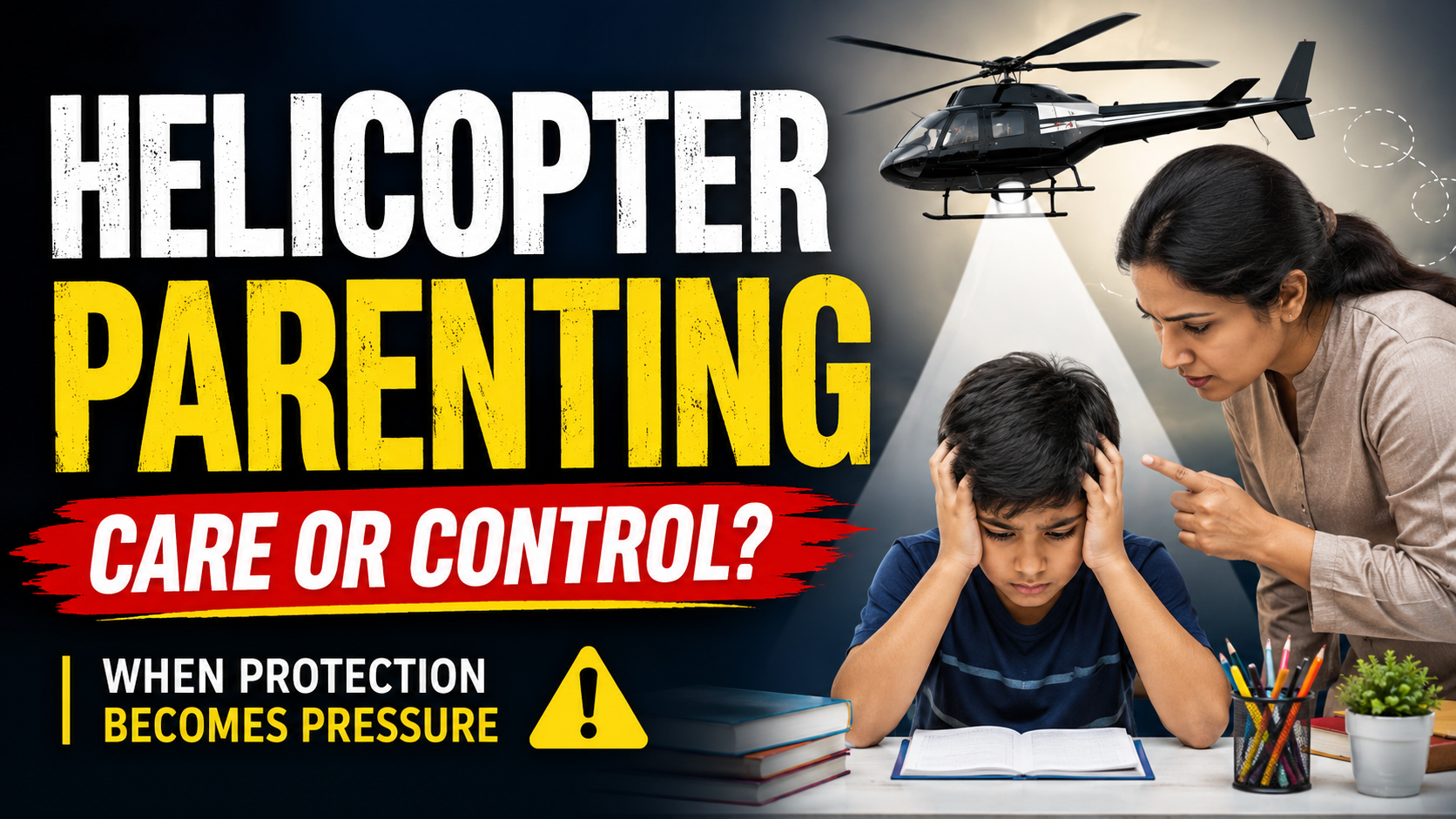
In many families, parents naturally want to protect their children from difficulties, failure and disappointment. However, when protection becomes excessive monitoring and control, it can turn into Helicopter parenting. This parenting style involves staying constantly involved in a child’s life and attempting to control almost every aspect of their activities and decisions.
What Is Helicopter Parenting?
Helicopter parenting refers to a pattern in which parents remain excessively involved in their child’s life, even when the child is capable of handling situations independently. Parents may continuously check where their child is, what they are doing, whom they are talking to and how they are spending their time.
The intention may be protection, but excessive involvement can gradually reduce the child’s opportunity to develop independence.
When Guidance Becomes Control
A parent can guide a child without controlling every decision. Problems arise when parents make decisions about friendships, hobbies, games, education, career choices and even relationships without considering the child’s interests or developmental needs.
Sometimes, parents also give excessive instructions while the child is performing a task they can already manage. Too many instructions can create confusion and make the child feel that they cannot do anything correctly without parental supervision.
Healthy parenting gradually gives children more responsibility as they become capable of handling it. Helicopter parenting, on the other hand, may continue controlling the child even after the child reaches adulthood.
Fear Behind Excessive Parenting
Helicopter parenting does not usually come from a desire to harm the child. In many cases, parental behaviour may be driven by fear.
Fear of failure, rejection, loss, judgement or danger can make parents constantly monitor their children. A parent may think, “If I control everything, my child will not make a mistake.”
But mistakes are an important part of development. Children need opportunities to experience manageable failure, solve problems and learn from consequences.
Possible Effects on Children
Excessive parental control can interfere with the development of autonomy and self-confidence. Some children may become dependent on their parents when making decisions, while others may become highly secretive or rebellious because they feel constantly controlled.
They may also struggle with decision-making, problem-solving and tolerating uncertainty. These effects do not occur in every child, and Helicopter parenting alone does not automatically cause trauma or a mental disorder. The child’s temperament, family environment and severity of parental control also matter.
Importantly, helicopter parenting should not be equated with abusive parenting. Abuse involves harmful behaviour such as physical, sexual or emotional maltreatment. Excessive control can still be psychologically unhealthy without being classified as abuse.
Does Parenting Need to Continue Into Adulthood?
Parental support remains valuable even when children become adults. However, adult children need increasing autonomy in areas such as career, relationships, finances and personal decisions.
Parents can offer advice without demanding obedience. A useful principle is: help when help is needed, guide when guidance is requested, and allow independence when the person is capable of managing alone.
Protection Without Taking Away Independence
Good parenting is not about staying behind the child at every step. It is about preparing the child to eventually walk independently.
If a child feels uncomfortable with excessive parental involvement, that feeling deserves attention. At the same time, parents and children can discuss boundaries without turning the conversation into blame or confrontation.
The goal is not to become a completely uninvolved parent. The goal is to create a relationship where care does not become control, guidance does not become domination, and protection does not prevent independence.