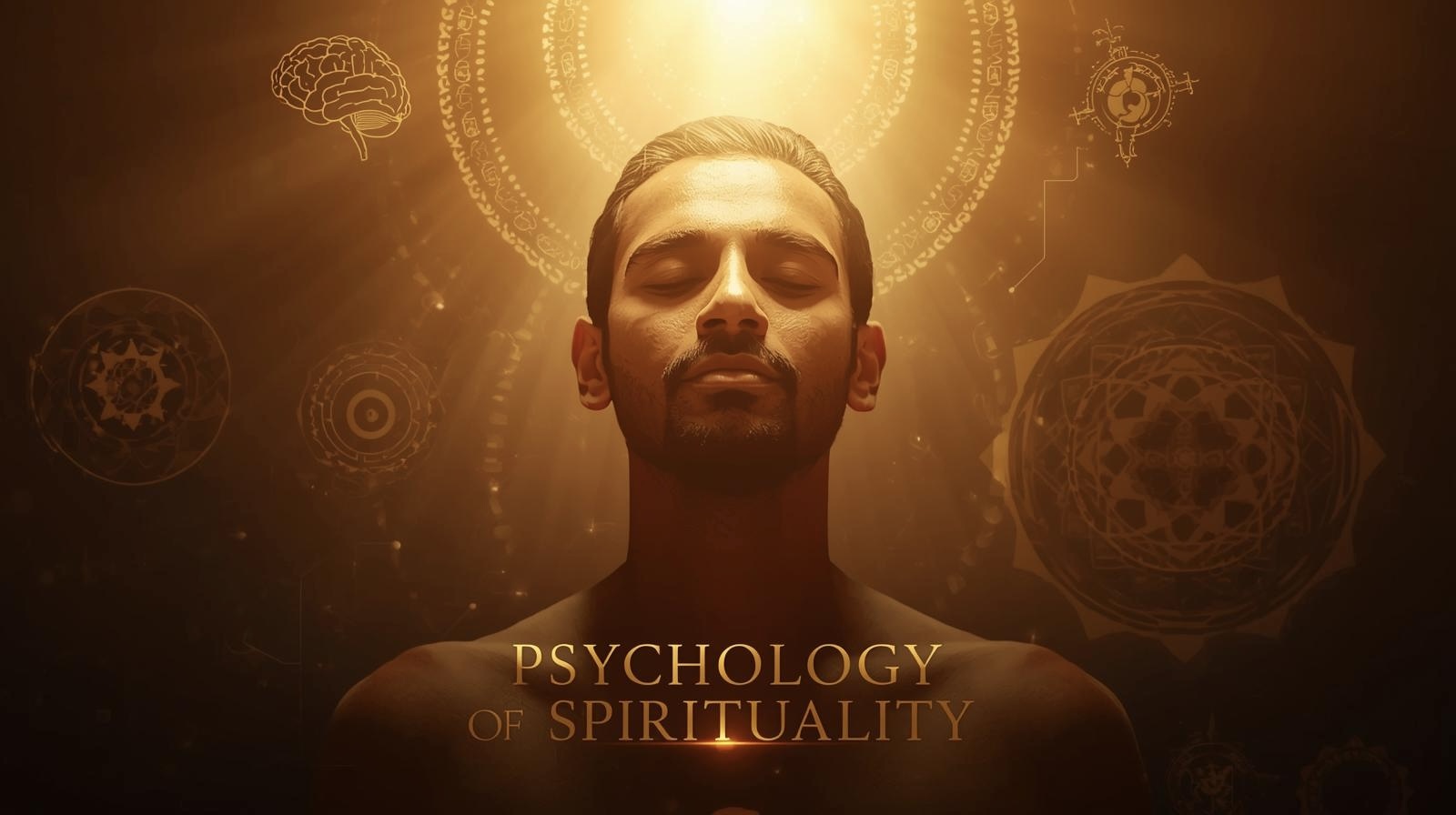
The psychology of spirituality is much deeper than rituals, religion, or blind belief. Both modern psychology and the ancient Vedas agree on one central truth:
real spirituality is the ability to understand, control, and transform your inner emotional world.
The Upanishads describe spirituality as the discovery of the true Self (Ātman), while psychology explains it as awareness of thoughts, emotions, and the subconscious mind. These two paths beautifully merge into one science of inner mastery.
Vedic Meaning of Spirituality: Knowing the True Self
In the Vedas and Upanishads, spirituality means uncovering the deepest identity beyond body and mind. It is the process of realizing that:
- You are not the body
- You are not the mind
- You are pure consciousness (Ātma)
This awareness leads to inner freedom, emotional clarity, and deep stability. The statement “Tat Tvam Asi” (You are That) captures the idea that individual consciousness and universal consciousness are one.
This Vedic understanding forms the spiritual foundation of the psychology of spirituality.
Emotional Transformation: The Scientific Side of Spirituality
In psychological terms, spirituality is the ability to shift emotions consciously. It is the inner skill to convert emotional states such as:
- Fear into courage
- Anxiety into confidence
- Sadness into strength
- Confusion into clarity
This emotional transmutation is not wishful thinking—it is a trained neuro-emotional ability.
It allows a person to control their inner states without depending on external support.
This is where modern therapy and the psychology of spirituality meet Vedic mastery.
Witnessing Mindset: Vedic Sakshi Bhava Meets Psychology
The Upanishads describe Sakshi Bhava, the ability to watch thoughts and emotions without becoming them.
Psychology calls this mindfulness and emotional acceptance.
When you watch your emotions without resistance:
- Stress drops
- Inner balance rises
- Thinking becomes clear
- Reactions turn into conscious responses
This witnessing state is the bridge between ancient spiritual practice and modern psychological science.
Subconscious Mind: The Hidden Power Source
The subconscious mind stores old memories, emotional wounds, fears, and belief programs.
Spiritual and psychological growth becomes possible only when you learn to access and control the subconscious mind.
Through breathwork, meditation, hypnotherapy, or deep introspection, you can:
- Release old emotions
- Rewrite beliefs
- Heal inner wounds
- Install new confidence
- Strengthen emotional freedom
This deeper transformation is the core engine of the psychology of spirituality.
Inner Alignment: The True Vedic Enlightenment
In the Vedic sense, enlightenment is not supernatural. It is a state of:
- Awareness
- Acceptance
- Emotional mastery
- Freedom from compulsive thinking
Psychology defines this as optimal mental functioning.
Vedas call it Moksha.
Both point toward the same inner alignment.
Conclusion
The psychology of spirituality blends ancient Vedic wisdom with modern psychological science. It teaches you how to understand emotions, transform them, upgrade your subconscious mind, and live with inner clarity. Master your inner world, and life naturally becomes peaceful, strong, and deeply meaningful.