
Long-term relationships are not always emotionally stable. Over time, emotional distance, lack of appreciation, poor communication, and unmet needs can slowly change the direction of a relationship. In many cases, people themselves may not realise this shift until emotional attachment starts developing outside the relationship.
This is where an Extramarital Relationship Vulnerability test becomes useful. The purpose of this test is not to label someone as “good” or “bad.” Instead, it helps identify emotional vulnerability, hidden dissatisfaction, and the possibility of emotional boundary crossing.
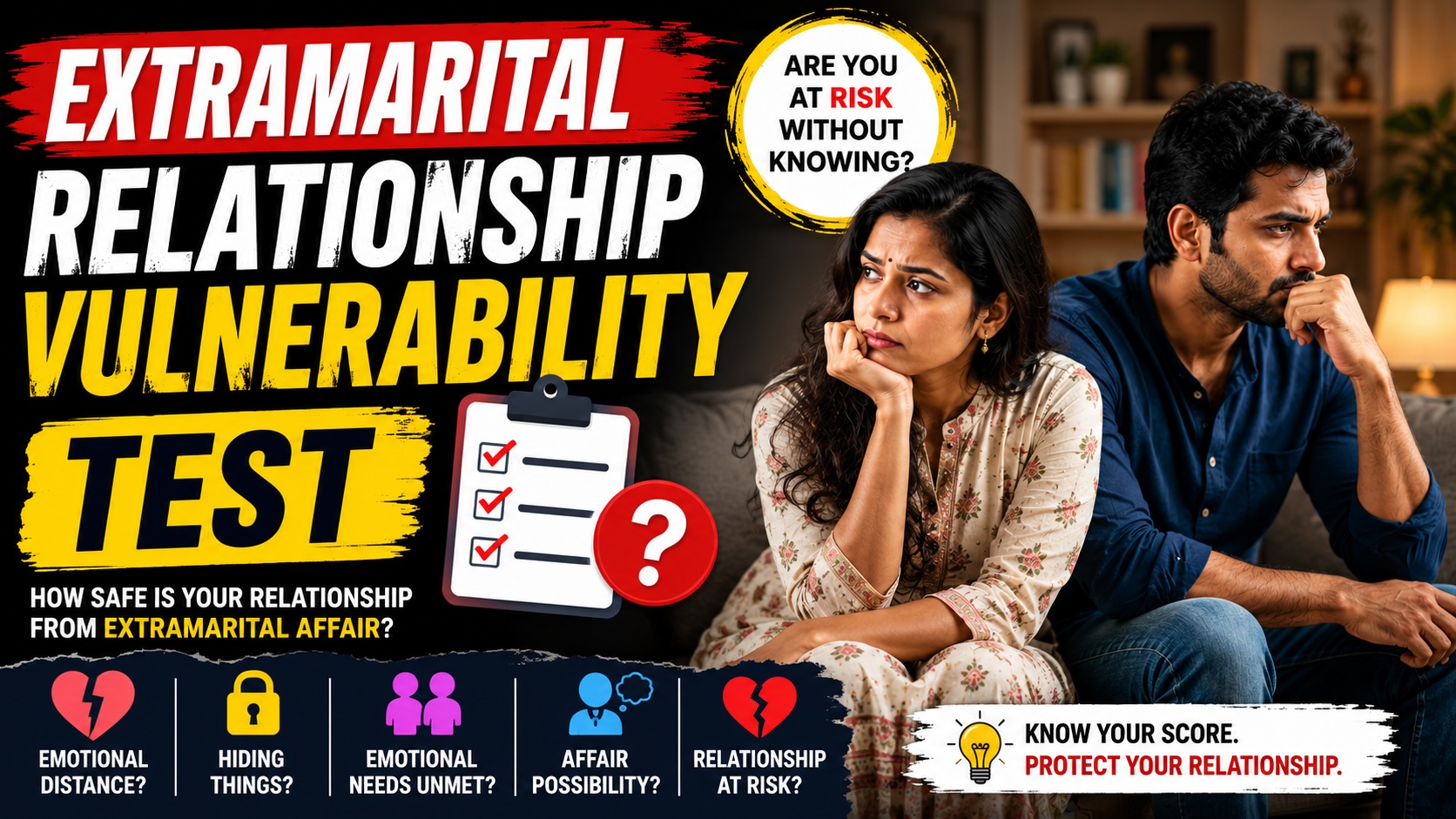
Why an Extramarital Assessment Test Matters
Many people think extramarital affairs happen suddenly. Psychologically, that is rarely true. Most emotional affairs begin with:
- emotional loneliness,
- feeling unheard,
- lack of appreciation,
- emotional comparison,
- or external validation.
An Extramarital assessment test helps people understand whether their relationship is emotionally healthy or slowly moving toward danger zones.
How to Take the Extramarital Relationship Vulnerability Test
For each question, choose a score:
- No – 0
- Occasionally – 1
- Sometimes – 2
- Mostly – 3
Add all the points together.
Questions in the Extramarital Assessment Test
- Do you feel emotionally closer to someone else than your partner?
- Do you hide certain communications or interactions from your partner?
- Do you feel another person understands you better or makes you happier than your partner?
- When emotionally weak, do you feel like sharing problems with someone other than your partner?
- Do you feel your partner does not understand, value, or appreciate your efforts?
- After enjoyable interactions with others, do moments with your partner feel boring or stressful?
- Have you felt that attention, appreciation, or care from others feels stronger than what your partner gives?
- Do you compare your partner with someone else’s partner?
- Have you thought your current relationship may never become emotionally or physically satisfying?
- If someone openly showed romantic interest and secrecy was guaranteed, would you continue that interaction?
Score Interpretation
Score 0–6
Currently, there is very little possibility of an extramarital affair. Emotional bonding and relationship stability are comparatively healthy.
Score 7–13
Small relationship problems exist. Right now, the risk is low, but if emotional distance increases, vulnerability may rise.
Score 14–20
There is noticeable emotional vulnerability. People in this category may not consciously plan an affair, but emotional dependency outside the relationship can gradually happen.
Score 21–26
You are emotionally exhausted and standing near your tolerance limit. The possibility of emotional or physical involvement outside the relationship is high.
Score 27–30
If guilt, fear, or social consequences reduce, there is a strong possibility of entering an extramarital relationship without considering the current partner.
Extramarital Relationship Vulnerability test – click here to download
When to Seek Help
The last two categories often include couples who emotionally separated long ago but continue the relationship due to children, family pressure, social image, or financial reasons.
This is why early intervention matters. Proper communication, emotional repair, and couple counselling at the right time can prevent serious emotional damage.
An Extramarital Relationship Vulnerability test is not about judging people. It is about understanding emotional reality before relationships break silently.