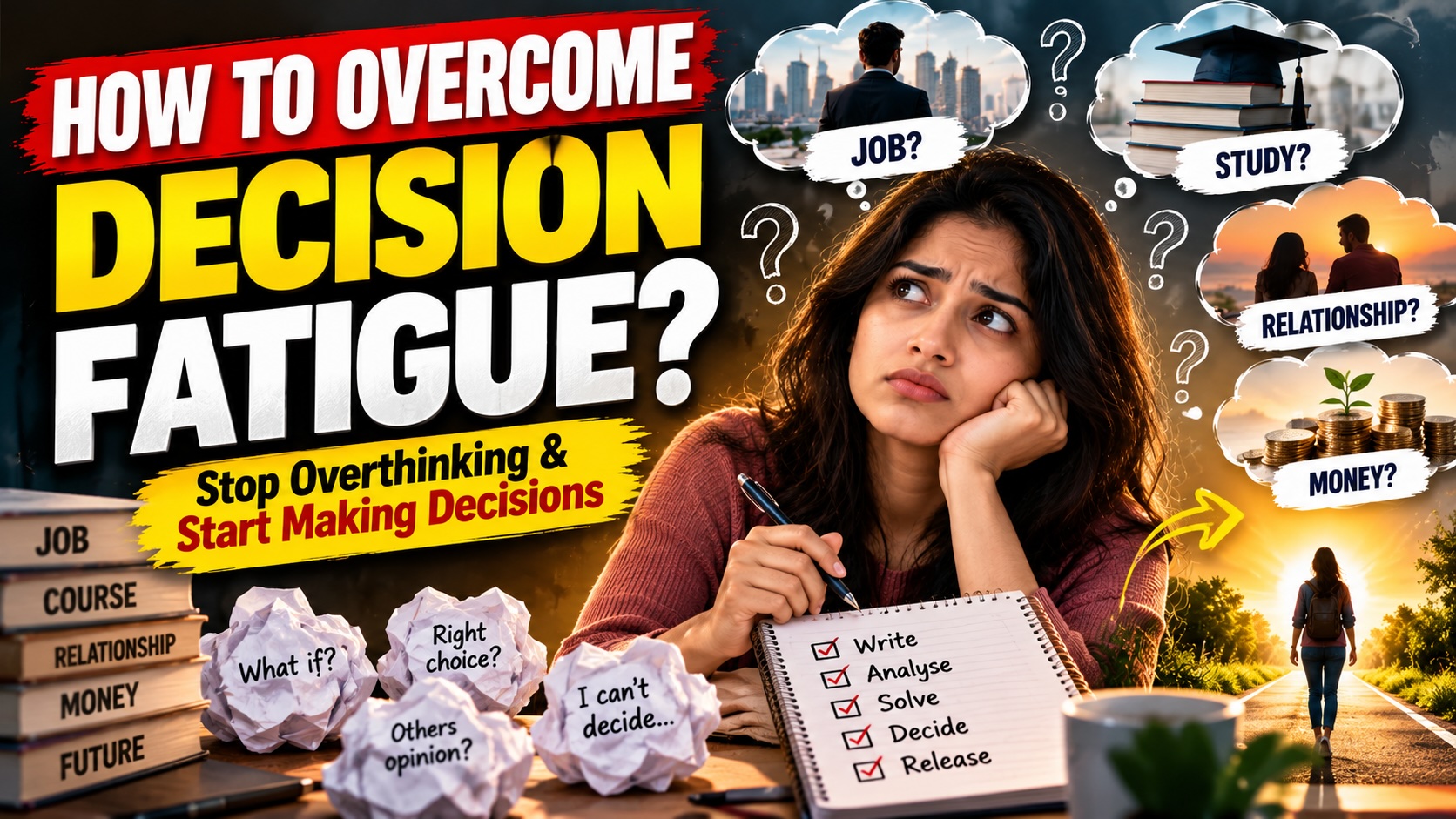
Are you someone who keeps overthinking every decision, depends on other people to choose for you, or repeatedly postpones important choices? Learning how to overcome decision fatigue does not always mean trying to think harder. Sometimes, you need to organise your thoughts and create a structured decision-making process.
Decision fatigue can make even ordinary choices feel mentally exhausting. Anxiety, uncertainty, fear of mistakes and excessive dependence on other people’s opinions can make decision-making even more difficult.
The following exercise can help you practise making decisions independently, one step at a time.
Step 1: Write Down Your Pending Decisions
Start by writing down every decision you are currently postponing.
For example:
- Choosing a job
- Selecting a course
- Making a relationship decision
- Managing money
- Moving to another place
Now arrange them from the least difficult decision to the most difficult decision.
Example
Suppose you have three pending decisions:
- Which mobile phone to buy
- Which course to study
- Whether to continue a relationship
Start with the mobile phone decision rather than immediately confronting the most emotionally difficult choice.
This gradual approach is an important part of learning how to overcome decision fatigue.
Step 2: Write Down the Realistic Options
For each decision, write down the realistic options that come to your mind.
For example, if your decision is about choosing a course, your options might be:
- BTech
- BSc Mathematics
- Forestry
Write the options in the order in which they naturally come to your mind. Do not immediately ask someone else what you should choose.
The purpose is to first understand your own preferences.
Step 3: Identify the Barrier Behind Each Option
Now look at every option and ask:
“What is stopping me from choosing this?”
The barrier could be:
- Fear
- Money
- Lack of time
- Fear of failure
- Fear of responsibility
- Fear of judgment
- Family expectations
- Uncertainty about the future
Example
BSc Mathematics:
Barrier — “I am afraid I may not get a good job.”
Forestry:
Barrier — “I don’t know whether I will enjoy the career.”
This step helps separate the decision itself from the fear surrounding the decision.
Step 4: Find a Practical Solution for Every Barrier
Do not simply write the problem. Write at least one possible solution.
For example:
Problem: “I am afraid I won’t get a job after BSc Mathematics.”
Possible solutions:
- Research career options.
- Explore higher-study opportunities.
- Speak to professionals in the field.
- Develop additional skills.
The objective is not to eliminate every possible risk. It is to identify whether the barrier has a workable solution.
Step 5: Compare the Solutions and Choose
Now read the solutions for each option carefully.
Ask:
“Which option has more workable ways to handle its barriers?”
You do not need a perfect decision. You need a reasonable and workable decision based on the information available.
This is one of the most practical principles in learning how to overcome decision fatigue.
Once you choose, write:
“This is my decision based on the information I currently have.”
Step 6: RELEASE the Decision
This is the final and often most important part.
Close your notebook. Take a few slow breaths and tell yourself:
“I have examined my options.”
“I identified my barriers.”
“I found solutions.”
“I made my decision.”
“I don’t need to repeatedly reopen this decision.”
“I can face the problems that may come.”
Then move forward.
This creates a psychological shift from:
Decision → Doubt → Rechecking → Overthinking
to:
Write → Analyse → Solve → Decide → Release.
Practise One Decision at a Time
Do not begin with the most frightening decision. Practise with one small decision today. Take the next decision tomorrow and gradually work towards the decisions that create the greatest emotional difficulty.
The goal of how to overcome decision fatigue is not to make every decision instantly. It is to develop the ability to evaluate your options, identify your barriers, find solutions and trust yourself enough to move forward.
If someone you know constantly depends on others for decisions, don’t simply give them the answer. Teach them how to make the decision themselves.