
Sometimes, the moment we openly talk about our worries, we feel lighter. Sharing our thoughts often reduces stress and gives us clarity. Yet many people today find themselves saying, “I have nobody to talk to.”
The problem is not always the absence of people. The real problem is that we often do not know whom to trust. If you share your deepest feelings with the wrong person, the result can be more painful than helpful.
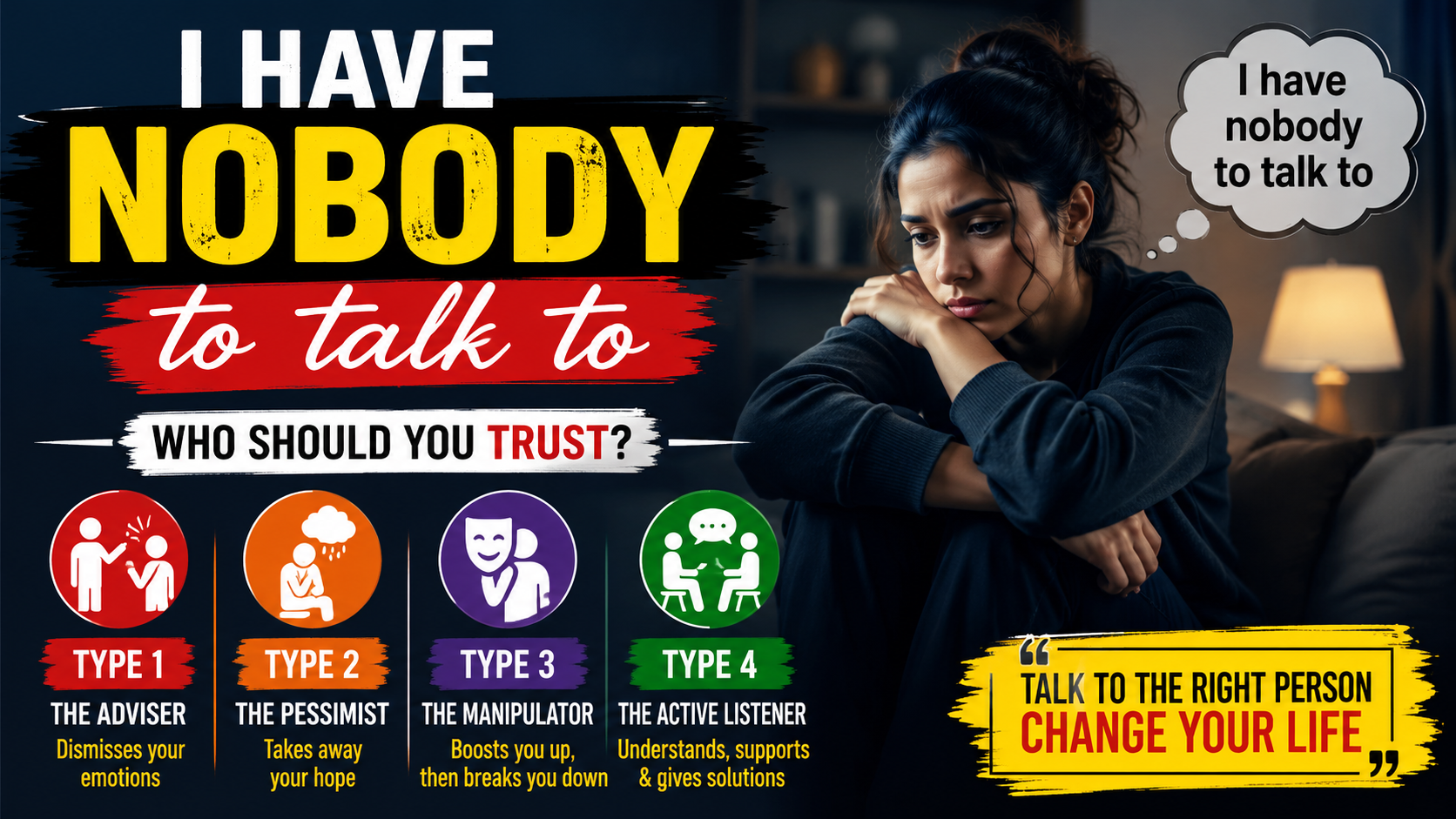
Let us look at the different types of people you may encounter.
Type 1: The Adviser
These people listen to your problems and immediately start giving advice.
They may say things such as:
- “Forget about it.”
- “Everyone goes through this.”
- “I have faced much worse situations.”
Although they may have good intentions, they often dismiss your emotions. Instead of understanding your pain, they compare it with other people’s struggles.
If you already feel that I have nobody to talk to, speaking to this type of person may make you feel even more isolated.
Your emotions deserve acceptance, not rejection.
Type 2: The Pessimist
These people absorb your worries and add their own negativity.
Their responses usually sound like this:
- “What can we do?”
- “Life is difficult.”
- “Everything is fate.”
- “Things will never change.”
Instead of giving you hope, they take away the little hope you already have.
Negative emotions are contagious. When two distressed minds come together without any solution, the situation often becomes worse.
Type 3: The Manipulator
This type of person is much more difficult to identify.
At first, they make you feel powerful, confident, and motivated. They constantly encourage you and make you feel special. Gradually, you become emotionally dependent on them.
Eventually, the attention and support start to disappear. As a result, you feel weaker than before.
If you often think, “I have nobody to talk to,” manipulators can easily take advantage of your emotional vulnerability.
Be careful about whom you trust.
Type 4: The Active Listener
These are the people you should look for.
An active listener does not judge you, reject your emotions, or manipulate you. Instead, they listen carefully, understand your perspective, and help you find practical solutions.
They provide three things:
- Emotional support
- Peace of mind
- A clear direction
Most importantly, they encourage independence instead of dependence.
When you say, “I have nobody to talk to,” an active listener can help you regain confidence and hope.
Choose Wisely
Every person who listens is not necessarily the right person to trust. The people around us can influence our emotions, thoughts, and decisions.
If you believe I have nobody to talk to, take the time to find someone who listens without judging you. The right person can change the course of your life.
If you already have such a person in your life, appreciate them. They are much rarer than you think.