
In the previous article, we discussed Retroactive jealousy, where a person experiences jealousy when thinking about their current partner’s past romantic, sexual, or emotional relationships. Several people who recognised these symptoms may wonder whether they have the same problem or Relationship OCD (ROCD).
Although Retroactive jealousy vs Relationship OCD can look very similar, they are not exactly the same. The thoughts can overlap, but the emotional pattern and the behaviours that maintain the problem can differ.
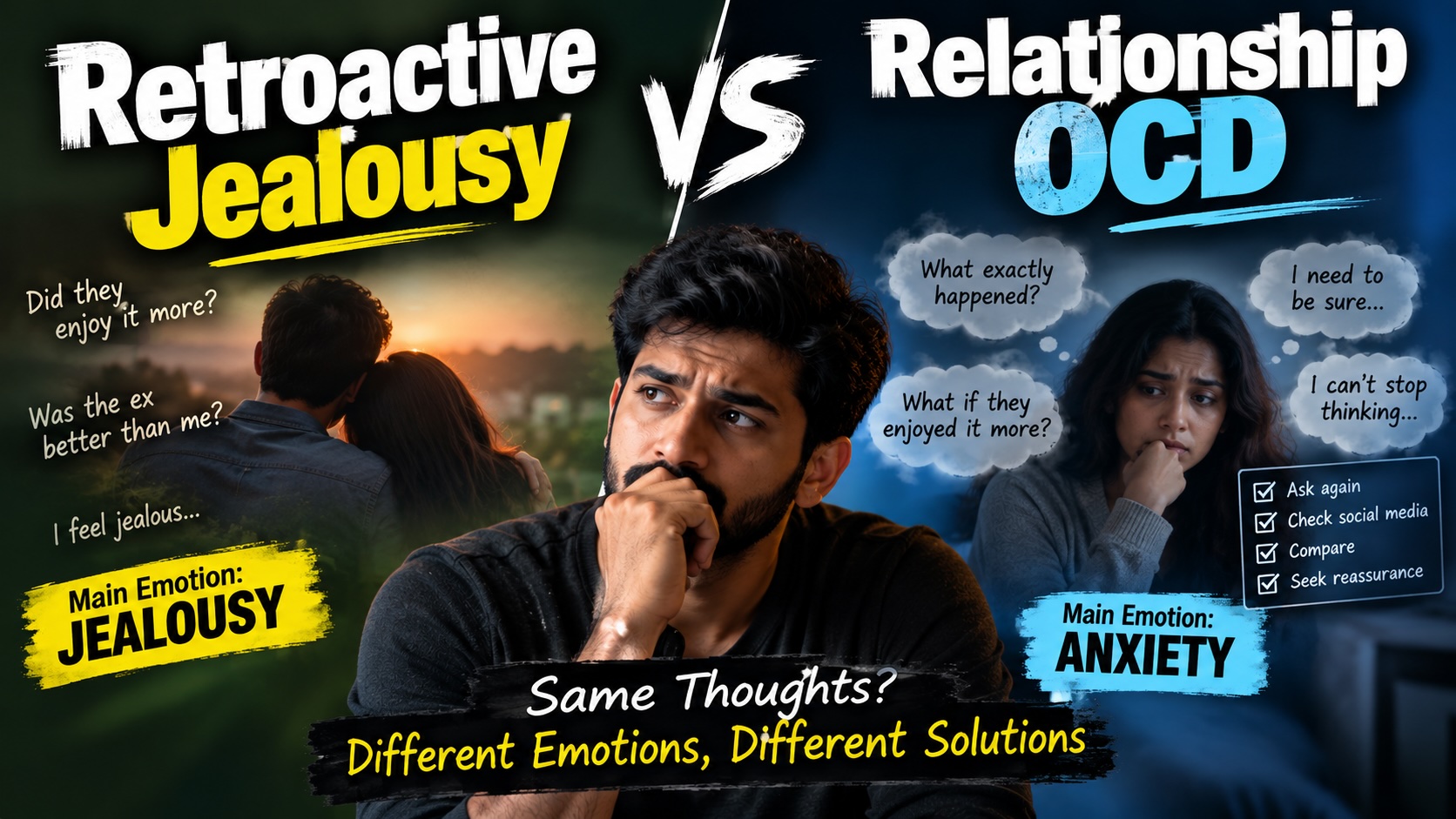
What Is Retroactive Jealousy?
In Retroactive jealousy, the main emotional reaction is jealousy about the partner’s past. The person may think about their partner’s previous lover and imagine the romantic, emotional, or sexual experiences they may have shared.
Thoughts may include:
- “Were they happier together?”
- “Did my partner enjoy those moments more?”
- “Was their physical relationship better?”
- “Am I not as good as the ex?”
The person may compare themselves with the previous partner and feel inferior in areas where they believe the ex was better. They may also feel proud when they think they are superior in some area.
What Is Relationship OCD?
Relationship OCD involves unwanted, repetitive doubts and obsessive thinking about the relationship. The person may continuously search for certainty about their feelings, their partner’s feelings, compatibility, attraction, or the meaning of particular relationship experiences.
The important feature is not simply having doubts. The person may feel an intense need to resolve the uncertainty.
They may repeatedly analyse their thoughts, ask their partner for reassurance, compare themselves with an ex, check social media, or mentally review past events. These behaviours may provide temporary relief, but the doubt can return again.
The Same Thought Can Look Different
Consider this thought:
“Was my partner’s sexual experience with their ex better than their experience with me?”
A person experiencing Retroactive jealousy may primarily feel jealousy, inferiority, hurt, or comparison. Their attention may remain focused on the ex and the perceived competition.
A person with an OCD pattern may become trapped in questions such as:
“What if they enjoyed it more? What exactly happened? What if I never know the truth? What does that mean about our relationship? I need to find out before I can feel peaceful.”
They may then repeatedly question their partner, check social media, compare physical characteristics, mentally replay situations, or search for reassurance.
Retroactive Jealousy vs Relationship OCD: The Key Difference
The simplest way to understand Retroactive jealousy vs Relationship OCD is:
Retroactive jealousy:
“I feel jealous about my partner’s past.”
Relationship OCD:
“I cannot tolerate the uncertainty, so I need to analyse, check, compare, or get reassurance until I feel certain.”
However, these patterns can overlap. A person can experience retroactive jealousy and also develop an OCD-type cycle around it. Therefore, the presence of jealousy alone does not establish OCD.
Why Correct Identification Matters
The therapeutic focus may differ depending on the maintaining mechanism. With Retroactive jealousy, therapy may focus on jealousy, comparison, insecurity, self-worth, and emotional responses to the partner’s past.
With an OCD pattern, treatment generally needs to address the obsession–compulsion cycle and the person’s difficulty tolerating uncertainty, rather than repeatedly providing reassurance or additional information.
Both patterns can affect relationships when they become persistent and difficult to control. Understanding the difference can help identify what is actually maintaining the distress and guide appropriate psychological support.